1 PSI Per 10 Degrees: The Chicago Winter Tire Math
November 10, 2026
First real cold morning of the season, and there it is. Your tire pressure light.
Yesterday, your dashboard was clear. Today, temperatures are below freezing, and your car is telling you something needs attention.
Before you assume you have a flat tire, consider what happened overnight.
Cold weather can lower tire pressure even when there's nothing wrong with the tire itself. And during a Chicagoland winter, a sudden temperature drop can be enough to trigger that warning light.
Here's the math behind it, what your tire pressure light actually means, and when it's time to get your tires checked.
Why Does Tire Pressure Drop When It's Cold?
Your tires don't need a puncture to lose pressure.
As temperatures fall, the air inside your tires cools, causing the pressure to decrease.
It's a normal response to changing temperatures, but it can leave your tires underinflated.
The rule of thumb is simple:
For every 10°F drop in temperature, your tires lose approximately 1 PSI.
PSI stands for pounds per square inch, the unit used to measure tire pressure.
So if your tires were properly inflated when it was 50°F outside, they could be several PSI lower after a week of freezing temperatures.
That's why tire pressure problems often seem to appear out of nowhere during Chicago's first cold snap.
The Chicago Winter Tire Math: How Much Pressure Can You Lose?
Chicagoland winters can bring major temperature swings, especially when a polar vortex moves through the area.
And those changes can have a noticeable effect on tire pressure.
Here's how the numbers work:
Temperature Drop. Approximate Pressure Loss
10°F 1 PSI
20°F 2 PSI
30°F 3 PSI
40°F 4 PSI
50°F 5 PSI
60°F 6 PSI
These are approximate changes, not exact measurements for every tire.
Imagine your tires were inflated to the recommended 35 PSI during a mild 40°F afternoon.
Then a polar vortex brings temperatures down to -10°F.
That's a 50-degree temperature drop, which could lower your tire pressure by roughly 5 PSI.
Your tires could now be sitting around 30 PSI without having a leak.
For drivers dealing with tire pressure in a Chicago winter, that difference is worth paying attention to.
Why Your TPMS Light Comes On During the First Cold Snap
Your Tire Pressure Monitoring System, or TPMS, is designed to alert you when tire pressure falls below a certain threshold.
During warmer weather, your tires may have enough pressure to stay above that threshold.
Then the first deep freeze arrives.
Pressure drops, the system detects the change, and your dashboard warning appears.
That's why drivers across DuPage, Kane, Kendall, and Cook counties often notice the light on the same freezing mornings.
Every first cold snap brings more drivers into our shops with tire pressure warnings. Often, the temperature is responsible, and correcting the pressure is a quick, free fix.
If you're seeing a TPMS light in DuPage County, don't assume you need new tires.
But don't ignore the warning, either.
Your Tire Pressure Light Is a Lagging Warning
Here's something many drivers don't realize.
Your TPMS light doesn't necessarily come on the moment your tire pressure begins dropping.
In many vehicles, the low-pressure warning activates only after one or more tires fall significantly below the manufacturer's recommended
pressure.
That makes TPMS a lagging indicator.
By the time the warning appears, your tires may already be underinflated enough to affect their performance.
Some vehicles display individual tire pressures, while others only show a warning symbol.
Either way, the next step is to check the actual pressure rather than guessing how much air you need.
Why Low Tire Pressure Matters on Icy Suburban Roads
A few PSI might not seem like much.
But low tire pressure can affect how your vehicle handles, stops, and wears through its tread.
Those changes matter when you're driving on snow-covered side streets or approaching an icy intersection.
Underinflated tires can contribute to:
- Reduced handling performance: Tires may respond less predictably when steering or cornering.
- Changes in braking performance: Improper inflation can affect stopping distances, especially when road traction is limited.
- Uneven tread wear: Low pressure can cause the outer shoulders of a tire to wear faster.
- Lower fuel economy: Increased rolling resistance makes your engine work harder.
- Excess heat buildup: Significantly underinflated tires can generate damaging heat during driving.
Whether you're commuting through Glendale Heights or navigating icy roads around St. Charles, proper tire inflation helps your tires perform as designed.
It won't eliminate winter road hazards, but it can help you avoid unnecessary tire-related risks.
Don't Use the PSI Number on Your Tire's Sidewall
If your tire pressure light comes on, you might look at the tire itself to find the correct PSI.
But the number printed on the sidewall generally indicates the tire's maximum inflation pressure.
That's not the same as the recommended pressure for your vehicle.
Your vehicle manufacturer determines the appropriate inflation pressure based on factors such as weight, handling, and tire specifications.
You'll usually find that recommendation on a sticker inside the driver's door jamb.
You can also check your owner's manual.
Always inflate your tires to the manufacturer's recommended cold pressure.
Adding extra air beyond that recommendation isn't a shortcut to better winter performance.
In fact, overinflation can create its own handling and wear problems.
If you're unsure what pressure your vehicle needs, Suburban Tire can check it for you.
Why Tire Pressure Should Be Checked Cold
For an accurate reading, check your tires before driving or after the vehicle has been parked for at least three hours.
That's because tire pressure rises as tires warm up during driving.
If you measure pressure immediately after a long commute, the reading may be higher than it would be when the tires are cold.
The recommended PSI on your door-jamb sticker is intended for cold tires.
For Chicagoland drivers, checking before your morning commute is often convenient.
If you've already been driving, don't release air just because the warm reading is higher than the cold-pressure recommendation.
Let the tires cool before making that adjustment.
Cold Weather or a Slow Leak? How to Tell the Difference
A tire pressure warning after a cold snap doesn't automatically mean you have a puncture.
But cold weather shouldn't be used to explain away every pressure problem.
Here's what to watch for.
Signs It's Probably a Temperature-Related Drop
- The warning appears after a major temperature decrease.
- Multiple tires show similarly lower pressure.
- None of the tires appear visibly damaged.
- Pressure remains stable after inflation is corrected.
Signs You May Have a Slow Leak
- One tire is significantly lower than the others.
- The same tire repeatedly needs air.
- The warning returns soon after a top-off.
- You notice a nail, puncture, or visible tire damage.
- Pressure keeps dropping even when temperatures remain steady.
A slow leak can come from a puncture, a valve issue, or a problem where the tire seals against the wheel.
If one tire keeps losing air, it's worth having it inspected rather than repeatedly adding more.
What Should You Do When Your TPMS Light Comes On?
If your tire pressure warning appears during a Chicago cold snap, follow these steps.
1. Find a safe place to stop.
If the vehicle feels unstable or a tire looks severely underinflated, avoid continuing to drive.
2. Check for visible damage.
Look for a flat tire, puncture, or anything unusual.
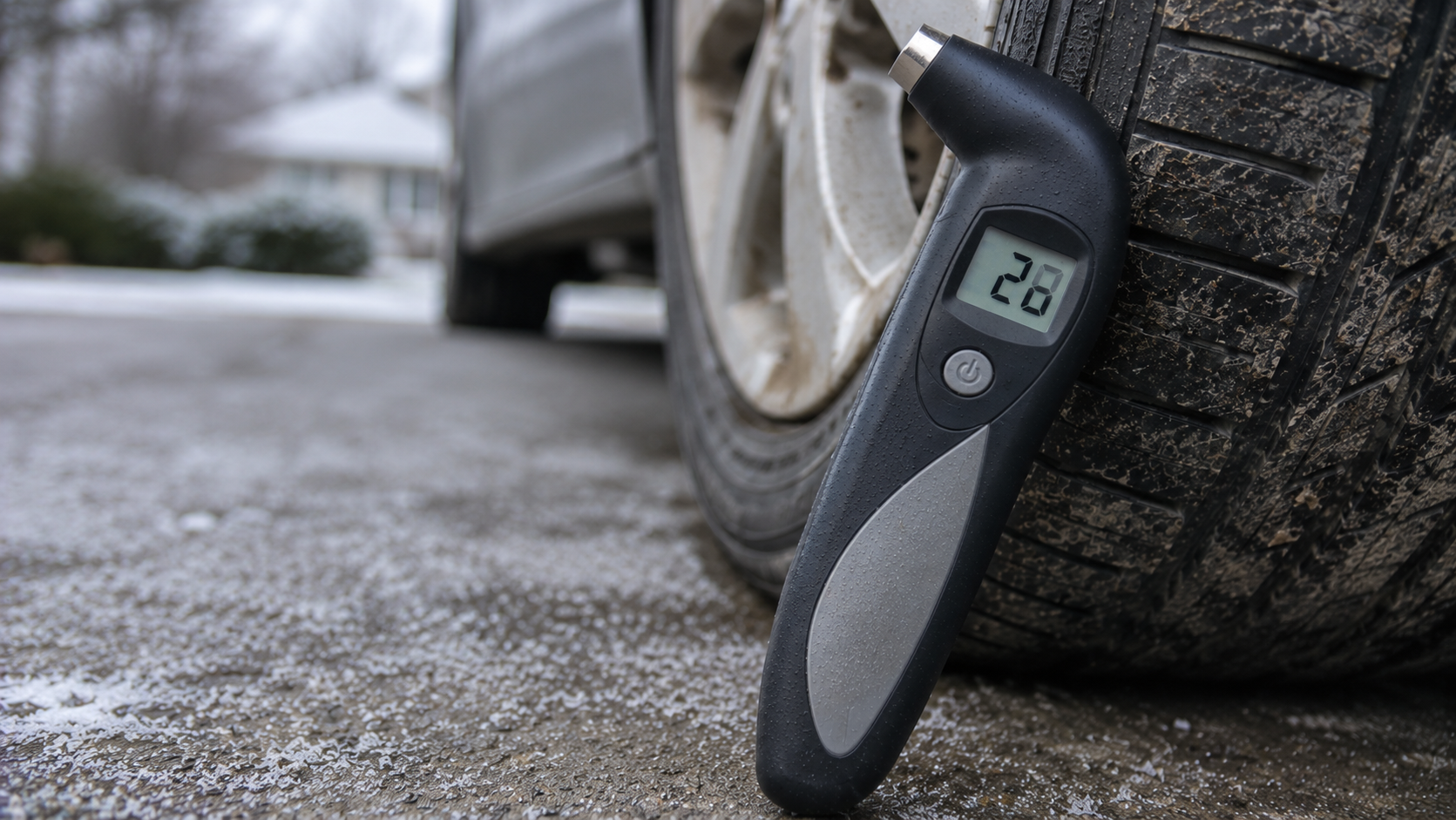
3. Measure your tire pressure.
Use a reliable gauge to check each tire.
4. Find the recommended PSI.
Look at the sticker inside your driver's door jamb.
5. Inflate to the correct pressure.
Adjust your tires to the manufacturer's recommended cold-pressure specification.
6. Check whether the warning clears.
Some TPMS systems update after a short drive, while others require a reset or recalibration procedure.
If the warning stays on or returns, have the tires inspected.
And if you don't have a pressure gauge handy, stop by Suburban Tire for a free tire pressure check.
How Often Should You Check Tire Pressure in Winter?
Don't wait for the warning light.
Checking your tire pressure at least once a month is a good habit, especially during winter.
It's also smart to check after a major temperature change or before a longer drive.
Remember, a 30-degree drop could mean approximately 3 PSI less pressure.
And during an especially cold week, the difference could be even greater.
Regular checks help you catch changes before they become large enough to trigger your TPMS.
For drivers dealing with low tire pressure in the cold suburbs, a quick monthly check can prevent plenty of unnecessary dashboard surprises.
What If Your Tire Pressure Light Won't Turn Off?
Sometimes, correcting your tire pressure is all it takes.
Other times, the warning light stays on.
Depending on your vehicle, the system may need to be driven for a short distance before updating.
Some vehicles also require a specific reset or recalibration procedure.
If the warning returns after you've corrected the pressure, one of your tires may still be losing air.
And if the TPMS light flashes before staying illuminated, that can indicate a problem with the monitoring system itself.
Don't ignore a warning that won't clear.
Have the tires and system checked so you know what's causing it.
A Free Tire Pressure Check Is Easier Than Guessing
You don't need to spend your morning searching for the right PSI or wondering whether your tires have a leak.
At Suburban Tire, we offer free tire pressure checks to help drivers get a quick answer.
Our team can check your tire pressures, adjust them to the correct specifications, and let you know if something needs a closer look.
If it's just the cold, we'll tell you.
If one tire is losing air faster than the others, we'll explain why an inspection may be necessary.
Our ASE-certified technicians understand the tire problems that come with Chicagoland's freezing temperatures.
And with convenient suburban locations, getting your pressure checked can be much easier than scheduling a dealership visit.
If your TPMS light is on, stop by for a free tire pressure check. No appointment needed for a quick top-off.
Keep Your Tires Ready for the Next Deep Freeze
Chicago winters can bring dramatic temperature changes, but your tire pressure doesn't have to be a guessing game.
Remember the math: approximately 1 PSI lost for every 10°F temperature drop.
Check pressure when your tires are cold, use the PSI listed on your vehicle's door-jamb sticker, and pay attention if one tire keeps losing air.
Suburban Tire serves Chicagoland drivers with locations in Glendale Heights, Hanover Park, DeKalb, St. Charles, Oswego, and Roselle, with Monday through Saturday hours.
Our ASE-certified technicians provide honest recommendations and practical help when winter tire problems appear.
Stop by your nearest Suburban Tire for a free tire pressure check before the next cold snap
.
We'll help you find out whether your tires just need air or something more, so you can get back to your day.
Featured Blogs & News